Week 6 — Social Cognition & Behavioral Game Theory第6週 — 社会的認知と行動ゲーム理論

June 4 (Thu), 20262026年6月4日(木)

Prof. Joseph Austerweilオウステウェイル ジョセフ教授

Social Cognition & Behavioral Game Theory社会的認知と行動ゲーム理論

Agendaアジェンダ

  • What is the other player thinking?相手は何を考えている? 0:00
  • People aren’t Nash人はナッシュではない 0:07
  • The beauty contest美人投票ゲーム 0:15
  • Theory of mind心の理論 0:30
  • Autism, theory of mind & the beauty contest自閉症・心の理論・美人投票ゲーム 0:53
  • Blame & intent非難と意図 1:11
  • One more gameもう一つのゲーム 1:33

1 · What is the other player thinking?1 · 相手は何を考えている?

Week 3: beliefs → action第3週:信念 → 行動

In Week 3 we solved the forward problem:

  • Given your beliefs about the zones and your utility over fish,
  • expected utility tells you what to do; ε-greedy is one solution.

Beliefs + values → action.

第3週では順方向の問題を解きました:

  • ゾーンについての信念と魚に対する効用が与えられたとき、
  • 期待効用が取るべき行動を教え、ε-greedyは一つの解でした。

信念 + 価値 → 行動。

Today: action → beliefs今日:行動 → 信念

Today we run the arrow backwards:

You watch someone act. What can you infer about what they believe, what they want, and how hard they’re thinking about you?

That inverse problem is theory of mind — the cognitive engine under every multi-agent system you’ve built.

今日は矢印を逆向きにします:

誰かが行動するのを見る。その人が何を信じ、何を望み、 そしてどれだけ深くあなたについて考えているかを、どこまで推論できるか?

この逆問題が心の理論です — これまで作ってきたすべてのマルチエージェント系の認知エンジンです。

You’ve already done this皆さんはもうやっている

  • MP3: your agents modeled each other — reciprocators waited to see if anyone else would cooperate; the trust system tracked whether claims matched catches.
  • MP4: you’re designing rules for agents who respond strategically to them — comply or defy based on trust and payoff.

Every one of those is a mind reading another mind. Today: how that actually works in people — and where it breaks.

  • MP3: あなたのエージェントは互いをモデル化していた — 互恵者は他の誰かが協力するか様子を見て、信頼システムは主張と漁獲が一致するか追跡した。
  • MP4: あなたは、ルールに戦略的に反応するエージェントのためのルールを設計している — 信頼と利得に応じて従うか背くか。

これらはすべて、ある心が別の心を読むことです。今日は、それが人間で実際にどう働くか — そしてどこで壊れるか。

Where we are現在地

  • What is the other player thinking?相手は何を考えている? 0:00
  • People aren’t Nash人はナッシュではない 0:07
  • The beauty contest美人投票ゲーム 0:15
  • Theory of mind心の理論 0:30
  • Autism, theory of mind & the beauty contest自閉症・心の理論・美人投票ゲーム 0:53
  • Blame & intent非難と意図 1:11
  • One more gameもう一つのゲーム 1:33

2 · People aren’t Nash2 · 人はナッシュではない

Classical game theory predicts… and people deviate古典的ゲーム理論の予測 … そして人はずれる

Classical game theory: what perfectly rational, self-interested players should do.

People deviate — but the deviations are systematic and modelable, not noise.

Same move as Week 3: a normative ideal, a descriptive reality, and a gap where the science lives. (Camerer, Behavioral Game Theory, 2003)

古典的ゲーム理論:完全に合理的で利己的なプレイヤーがすべきこと。

人はそこからずれる — しかしそのずれは体系的でモデル化できるもので、ノイズではない。

第3週と同じ動き:規範的理想、記述的現実、そしてその間のギャップに科学がある。 (Camerer, Behavioral Game Theory, 2003)

Let’s play: the ultimatum gameやってみよう:最後通牒ゲーム

There’s ¥1,000 to split. Everyone plays both roles — write down two numbers:

  • As proposer: your offer — how much of the ¥1,000 you’d give the responder.
  • As responder: the smallest offer you’d accept.

If an offer ≥ your threshold → split as proposed. If not → both get nothing.

¥1,000 を分けます。全員が両方の役をやります — 2つの数字を書いて:

  • 提案者として: あなたの提案額 — ¥1,000 のうち受け手にいくら渡すか。
  • 受け手として: 受け入れる最低額

提案額 ≥ あなたの閾値 → 提案通りに分配。そうでなければ → 両者とも何も得られない。

What people actually offer — ultimatum人が実際に提案する額 — 最後通牒

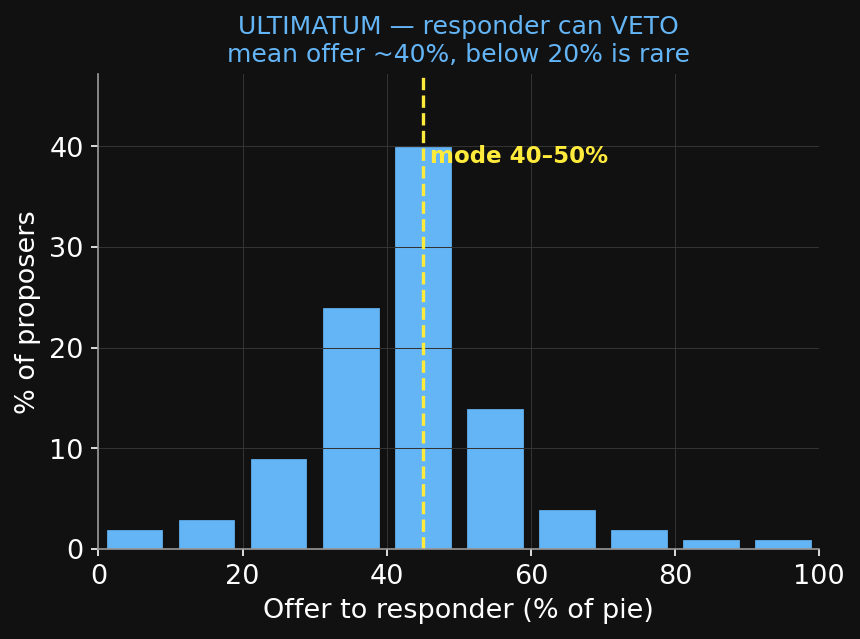
In Western lab samples (Güth et al. 1982; Camerer 2003 synthesis of 30+ studies):

  • Modal & median offer: 40–50% of the pie. Mean ≈ 40–45%.
  • Offers below ~20% are rejected about half the time (and more often as they shrink).
  • Almost no one offers more than 50%.

The rational prediction — offer the smallest positive amount, accept anything — is wrong. Responders pay to punish unfairness; proposers anticipate it.

How does this compare to our room?

欧米の実験室サンプルでは(Güth et al. 1982;Camerer 2003 が30以上の研究を総括):

  • 最頻・中央の提案:パイの40〜50%。平均 ≈ 40〜45%。
  • 約20%未満の提案は約半分の確率で拒否される(小さくなるほど拒否率は上がる)。
  • 50%を超える提案はほとんどない。

合理的予測 — 最小の正の額を提案し、何でも受け入れる — は間違い。受け手はコストを払って不公平を罰し、提案者はそれを見越す。

我々の部屋とどう違う?
Now remove the veto: the dictator game拒否権を外す:独裁者ゲーム

Same ¥1,000. One change: the responder has no veto — they just receive whatever you give.

You can keep everything with zero risk.

Write your new offer. Did it change from your ultimatum offer?

同じ¥1,000変更点は一つ: 受け手に拒否権がない — あなたが与えたものをただ受け取る。

あなたはリスクゼロで全額を取れる。

新しい提案額を書いて。最後通牒のときから変わった?

What people actually give — dictator人が実際に与える額 — 独裁者

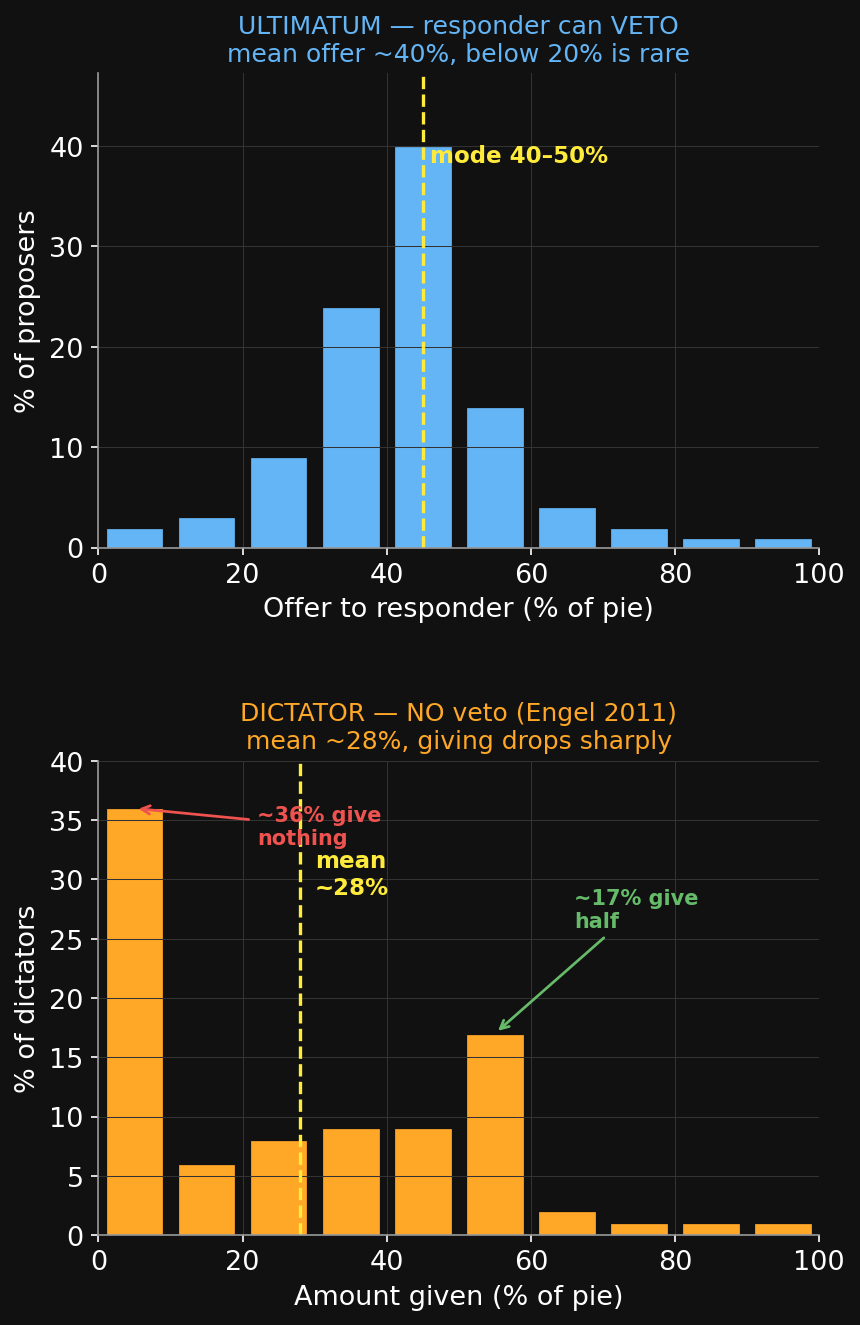
Engel (2011) meta-study — 600+ treatments, 100+ papers:

  • Mean given ≈ 28% (vs. ~40% in the ultimatum game).
  • ~36% give nothing. ~17% give exactly half. ~64% give something.

Removing the veto roughly halves giving. So part of “ultimatum fairness” was fear of rejection — but a real chunk of pure other-regard remains (most people still give something).

Engel (2011) メタ研究 — 600以上の処理、100以上の論文:

  • 平均で約28%を分配(最後通牒の約40%に対して)。
  • 約36%は何も与えない。約17%はちょうど半分。 約64%は何かを与える。

拒否権を外すと、分配はおよそ半分に。つまり「最後通牒の公平さ」の一部は拒否への恐れだった — しかし純粋な他者配慮もかなり残る(大半はそれでも何かを与える)。
The same games, different cultures同じゲーム、異なる文化

Almost all of that comes from Western university students. What happens elsewhere?

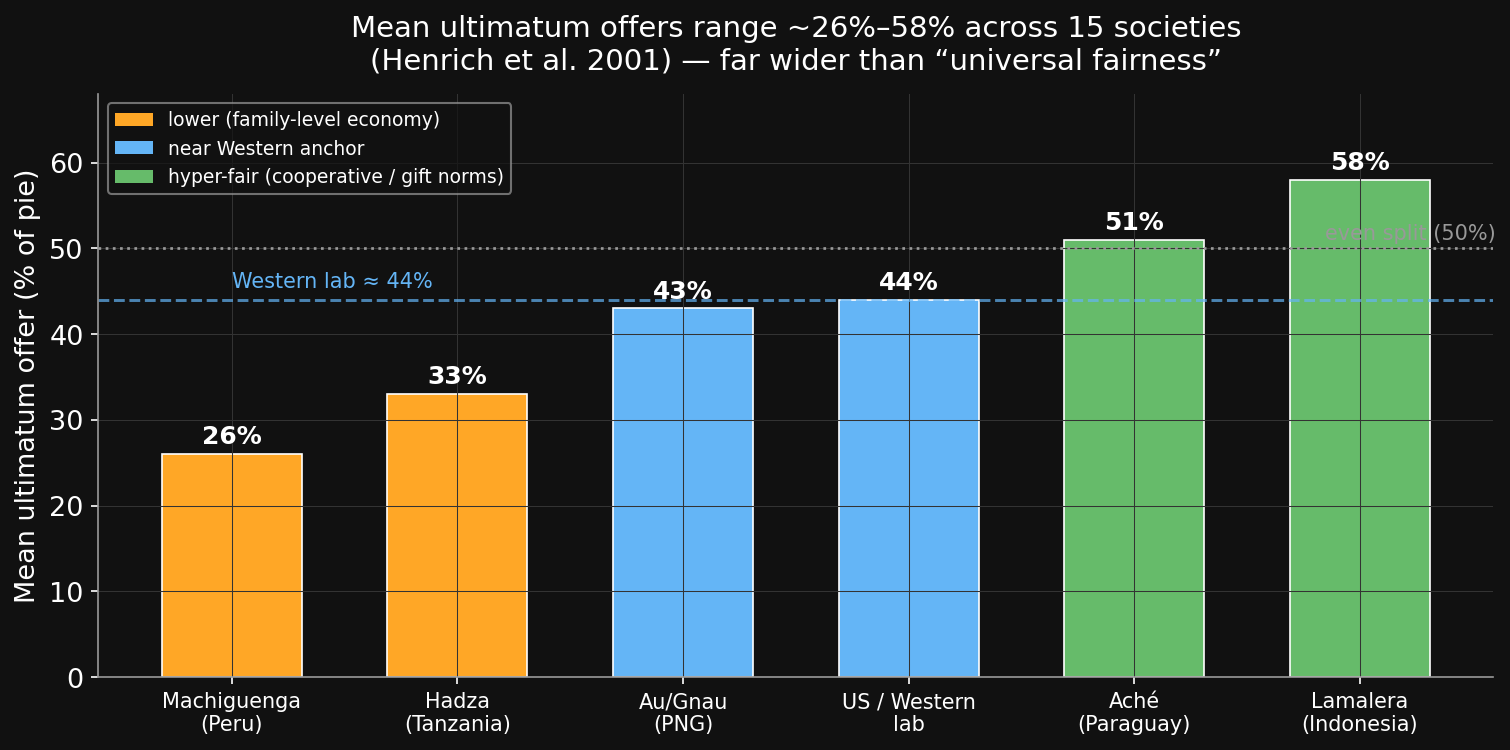
Henrich et al. (2001): ran the ultimatum game in 15 small-scale societies — Amazonian horticulturalists, African foragers, Indonesian whale hunters, Mongolian herders…

The “fair” 40–50% offer turns out not to be universal at all.

これらのほとんどは欧米の大学生から得られたもの。他の場所ではどうか?

Henrich et al. (2001): 15の小規模社会で最後通牒ゲームを実施 — アマゾンの園耕民、アフリカの狩猟採集民、インドネシアの捕鯨民、モンゴルの牧畜民…

「公平な」40〜50%の提案は、実はまったく普遍的ではないと判明した。

Offers range from 26% to 58%提案額は26%から58%まで

  • Machiguenga (Peru, family-level farming): mean ~26% — and almost no rejections, even of low offers.
  • Lamalera (Indonesia, cooperative whale hunters): mean ~58% — hyper-fair.
  • Au & Gnau (Papua New Guinea): often reject hyper-fair offers — accepting a big gift creates a debt.

The pattern: the more a society depends on cooperation in production and market exchange, the fairer the offers — these two factors explain ~68% of the variance across societies (Henrich et al. 2001).

  • マチゲンガ(ペルー、家族単位の農耕):平均約26% — そして低い提案でもほとんど拒否しない
  • ラマレラ(インドネシア、協同の捕鯨民):平均約58% — 超公平。
  • アウ族とグナウ族(パプアニューギニア):しばしば「超公平」な提案を拒否する — 大きな贈り物を受け取ると負債が生じるため。

パターン: 社会が生産における協力市場交換に依存するほど、提案は公平になる — この二つの要因が社会間のばらつきの約68%を説明する(Henrich et al. 2001)。
One pattern under all of itすべての根底にある一つのパターン

You can model every one of these results:

  • Inequity aversion (Fehr & Schmidt 1999): add a penalty for unequal payoffs to the utility function → predicts ultimatum offers, rejections, and dictator giving, with culture setting the weights.
  • Altruistic punishment (Fehr & Gächter 2002, Nature): people pay out of pocket to punish unfairness — and that sustains cooperation.

Callback to Grisha: Tit-for-Tat’s retaliation is altruistic punishment with a name. Callback to Week 3: same move — write a utility function that predicts the deviation.

これらの結果はすべてモデル化できる

  • 不平等回避(Fehr & Schmidt 1999):効用関数に不平等な配分へのペナルティを加える → 最後通牒の提案・拒否、そして独裁者の分配を予測。文化が重みを決める。
  • 利他的処罰(Fehr & Gächter 2002, Nature):人は自腹を切って不公平を罰し、それが協力を維持する

グリーシャへの参照: しっぺ返し戦略の報復性は、名前のついた利他的処罰。第3週への参照: 同じ動き — ずれを予測する効用関数を書く。

Where we are現在地

  • What is the other player thinking?相手は何を考えている? 0:00
  • People aren’t Nash人はナッシュではない 0:07
  • The beauty contest美人投票ゲーム 0:15
  • Theory of mind心の理論 0:30
  • Autism, theory of mind & the beauty contest自閉症・心の理論・美人投票ゲーム 0:53
  • Blame & intent非難と意図 1:11
  • One more gameもう一つのゲーム 1:33

3 · The beauty contest3 · 美人投票ゲーム

Let’s play. Pick a number 0–100.やってみよう。0〜100の数を選んで。

The winner is whoever’s closest to ⅔ of the average of everyone’s guess.

Write it down. No talking.

勝者は、全員の予想の平均の⅔に最も近い人。

書き留めて。相談はなし。

The reasoning ladder推論のはしご

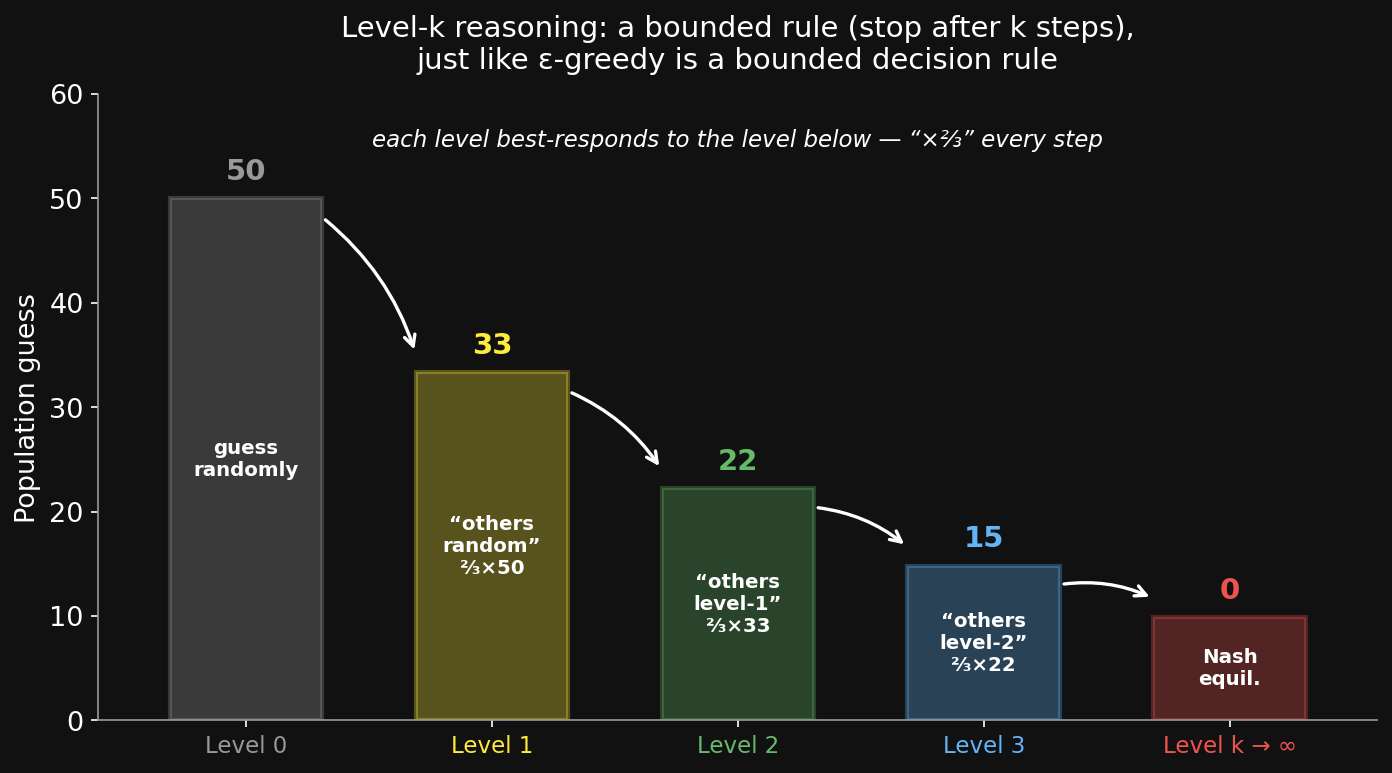
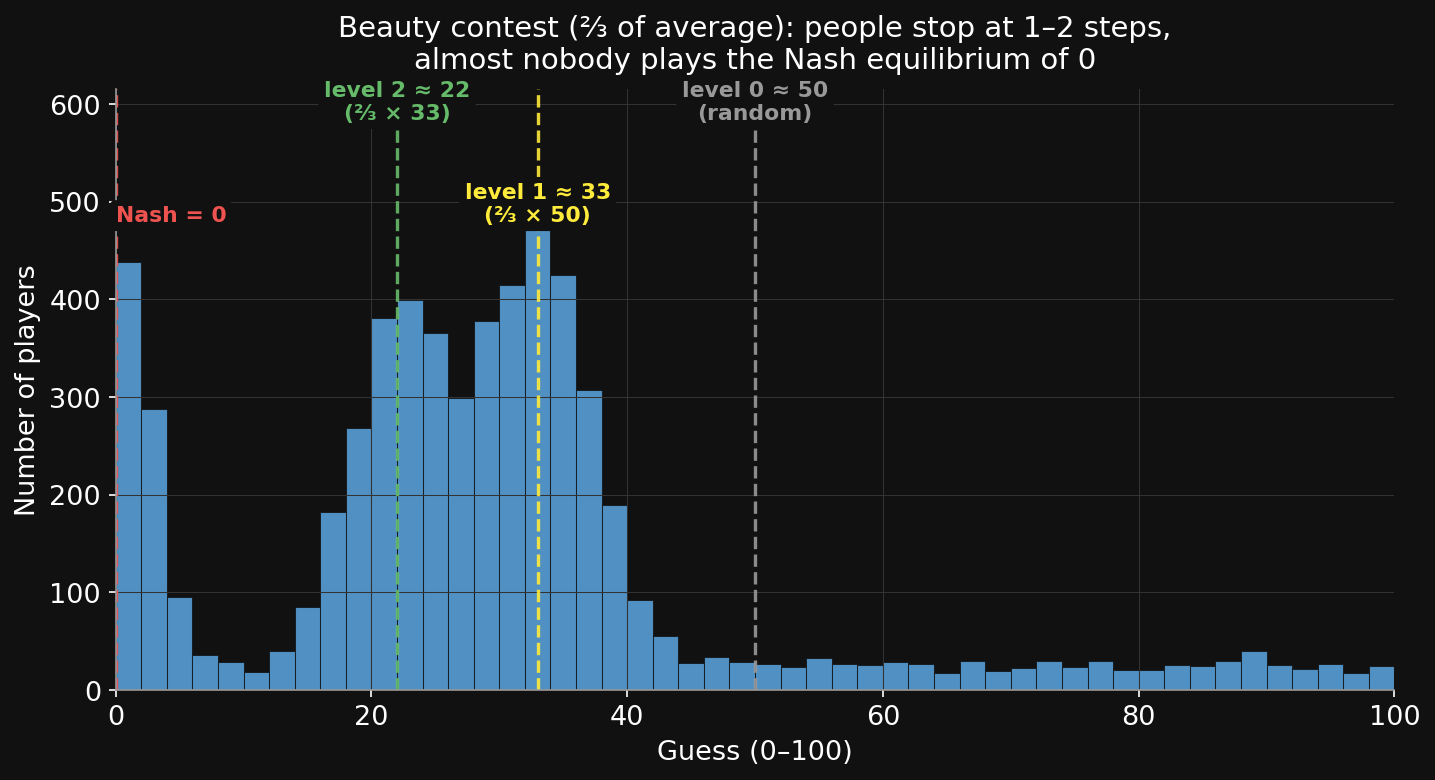
  • Level 0: guess randomly → average ≈ 50.
  • Level 1: “if others are random, I guess ⅔ × 50 ≈ 33.”
  • Level 2: “if others think that, I guess ⅔ × 33 ≈ 22.”
  • Iterate forever → the only Nash equilibrium is everyone guesses 0.

But did anyone here guess 0? Almost nobody ever does.

  • レベル0: ランダムに予想 → 平均 ≈ 50。
  • レベル1: 「他人がランダムなら、⅔ × 50 ≈ 33と予想」。
  • レベル2: 「他人がそう考えるなら、⅔ × 33 ≈ 22と予想」。
  • 永遠に反復 → 唯一のナッシュ均衡は全員が0と予想

でも、ここで0と予想した人は? ほとんど誰もいない。

Level-k reasoning ladder descending 50 to 33 to 22 to 15 to 0, each level best-responds to the level below

What people actually do人が実際にすること

Across thousands of players (Nagel 1995; Bosch-Domènech et al. 2002 newspaper experiments), guesses cluster at 33 and 22 — people do 1–2 steps, not infinite.

The cognitive-hierarchy model (Camerer, Ho & Chong 2004) puts the mean number of thinking steps at ≈ 1.5.

Depth of reasoning about other minds is not all-or-nothing — it’s a number, and you can measure it.

何千人ものプレイヤーで(Nagel 1995;Bosch-Domènech et al. 2002 の新聞実験)、予想は33と22に集中 — 人は1〜2ステップで、無限ではない。

認知階層モデル(Camerer, Ho & Chong 2004)は、平均の思考ステップ数を ≈ 1.5とする。

他者の心についての推論の深さは、全か無かではない — それは数値であり、測定できる。
Histogram of beauty-contest guesses with spikes at 33 and 22 and a smaller spike at 0

Where we are現在地

  • What is the other player thinking?相手は何を考えている? 0:00
  • People aren’t Nash人はナッシュではない 0:07
  • The beauty contest美人投票ゲーム 0:15
  • Theory of mind心の理論 0:30
  • Autism, theory of mind & the beauty contest自閉症・心の理論・美人投票ゲーム 0:53
  • Blame & intent非難と意図 1:11
  • One more gameもう一つのゲーム 1:33

4 · Theory of mind4 · 心の理論

From “how deep” to “what’s in there”「どれだけ深く」から「中に何があるか」へ

The beauty contest measured how many steps you reason about others.

But strategic depth presupposes something more basic: that you can represent what someone else believes — even when it’s false, even when it differs from what you know.

That capacity is theory of mind. Where does it come from, and how does it work?

美人投票ゲームは、他者について何ステップ推論するかを測りました。

しかし戦略的深さは、より基本的な何かを前提とします:他者が何を信じているか — それが誤りであっても、自分の知っていることと違っても — を表現できること。

その能力が心の理論です。それはどこから来て、どう働くのか?

The classic test: false belief古典的なテスト:誤信念

Theory of mind = attributing mental states to others (Premack & Woodruff 1978).

The false-belief task — Sally-Anne (Baron-Cohen, Leslie & Frith 1985):

Sally hides her marble in a basket and leaves. Anne moves it to a box. Sally comes back. Where will Sally look for her marble?

Passing requires representing a belief that differs from reality. Most children pass around age 4.

心の理論 = 他者に心的状態を帰属させること(Premack & Woodruff 1978)。

誤信念課題 — サリーとアン(Baron-Cohen, Leslie & Frith 1985):

サリーがビー玉をかごに隠して出て行く。アンがそれを箱に移す。サリーが戻ってくる。サリーはどこを探す?

正解するには、現実と異なる信念を表現する必要がある。多くの子どもは4歳頃に通過する。

Watch: the Sally-Anne task映像:サリーとアン課題

Watch the child’s answer — and the age at which it flips from “the box” (where it really is) to “the basket” (where Sally thinks it is). 子どもの答えに注目 — 「箱」(実際にある場所)から「かご」(サリーがいると思っている場所)へと、何歳で切り替わるか。

The computational turn計算論的転回

How does mature theory of mind actually work? Baker, Saxe & Tenenbaum (2009): “Action understanding as inverse planning.”

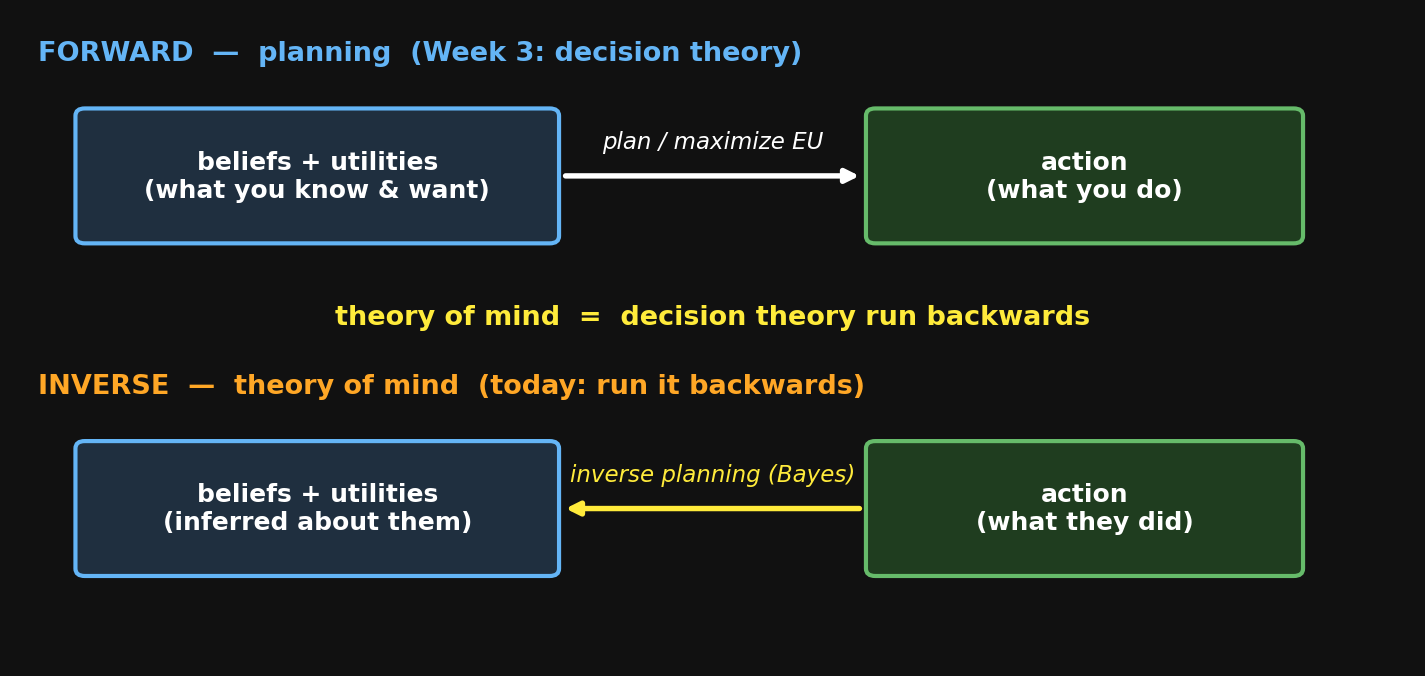
  • Week 3: beliefs + utilities → action (planning)
  • ToM: action → beliefs + utilities (inverse planning)

Theory of mind is your own decision theory, run backwards on someone else.

成熟した心の理論は実際どう働くのか? Baker, Saxe & Tenenbaum (2009):「逆プランニングとしての行動理解」。

  • 第3週:信念 + 効用 → 行動 (プランニング
  • 心の理論:行動 → 信念 + 効用 (逆プランニング

心の理論とは、自分の意思決定理論を他者に対して逆向きに動かすことです。

Forward planning (beliefs+utilities to action) vs inverse planning (action to beliefs+utilities)

The machinery is old; the evidence is what’s new仕組みは古い、新しいのは証拠

A fair caution: “infer preferences from choices, assuming utility-maximization” is just revealed preference — neoclassical economics, run in reverse. The theory isn’t new.

What is striking is the empirical reach:

  • Even toddlers infer others’ costs and rewards from a single choice, and expect agents to act efficiently (Jara-Ettinger et al. 2016; Liu et al. 2017, Science).
  • Inverse-planning models quantitatively predict adults’ moment-to-moment belief and desire attributions (Baker et al. 2017, Nat. Hum. Behav.).

So: not a new mechanism — the same utility-maximization you met in behavioral game theory — but deployed as mind-reading, from infancy.

正直な注意:「効用最大化を仮定して、選択から選好を推論する」は顕示選好 — 新古典派経済学を逆に回しただけ。理論は新しくない。

新しいのは、実証的な射程です:

  • 幼児でさえ、たった一度の選択から他者のコストと報酬を推論し、エージェントが効率的に行動すると期待する(Jara-Ettinger et al. 2016;Liu et al. 2017, Science)。
  • 逆プランニングモデルは、成人の刻々の信念・欲求の帰属を定量的に予測する(Baker et al. 2017, Nat. Hum. Behav.)。

つまり:新しい仕組みではない — 行動ゲーム理論で出会った効用最大化と同じ — しかし乳児期から、心を読むために使われている。

Break休憩

Where we are現在地

  • What is the other player thinking?相手は何を考えている? 0:00
  • People aren’t Nash人はナッシュではない 0:07
  • The beauty contest美人投票ゲーム 0:15
  • Theory of mind心の理論 0:30
  • Autism, theory of mind & the beauty contest自閉症・心の理論・美人投票ゲーム 0:53
  • Blame & intent非難と意図 1:11
  • One more gameもう一つのゲーム 1:33

5 · Autism, theory of mind & the beauty contest5 · 自閉症・心の理論・美人投票ゲーム

Theory of mind and autism: the classic finding心の理論と自閉症:古典的な知見

The Sally-Anne task wasn’t designed for children in general — it was designed to study autism (Baron-Cohen, Leslie & Frith 1985, “Does the autistic child have a theory of mind?”).

  • The classic result: many autistic children passed control questions but failed the false-belief question at higher rates than matched peers.
  • This launched the “mindblindness” hypothesis — autism as a specific difficulty representing others’ mental states.

For a long time this was the textbook story. The next results complicate it.

サリーとアン課題は、子ども一般のために作られたのではなく、自閉症を研究するために作られました(Baron-Cohen, Leslie & Frith 1985「自閉症児は心の理論を持つか?」)。

  • 古典的な結果:多くの自閉症児は統制質問には答えたが、誤信念質問には対応する仲間より高い割合で不正解だった
  • これが「マインドブラインドネス」仮説を生んだ — 自閉症を、他者の心的状態を表現する特異的な困難とみなす見方。

長らくこれが教科書的な物語でした。次の結果がそれを複雑にします。

Reframing it: the double-empathy problem再考:二重共感問題

The “mindblindness” story is one-sided — it measures autistic people reading neurotypical minds, and calls the gap a deficit.

Milton (2012), the double-empathy problem: the mismatch is bidirectional — each group struggles to read the other. Neurotypical people are no better at reading autistic minds than vice versa.

  • Recent work: autistic-to-autistic communication can be as effective as neurotypical-to-neurotypical.

Reframe, using our spine: not a broken module, but two differently-tuned inverse planners reading each other.

「マインドブラインドネス」の物語は一方的です — 自閉症の人が定型発達の心を読む能力を測り、その差を欠損と呼んでいる。

Milton (2012)、二重共感問題: ミスマッチは双方向 — 各集団がもう一方を読むのに苦労する。定型発達の人が自閉症の心を読むのは、その逆より上手いわけではない

  • 最近の研究:自閉症者同士のコミュニケーションは、定型発達者同士と同じくらい効果的でありうる。

再構成(スパインを使って):壊れたモジュールではなく、互いを読み合う異なる調整の逆プランナー二つ

So: a clean predictionでは:きれいな予測

Put the two threads together. The beauty contest requires recursive theory of mind — “I think that you think…”. Autism is classically associated with theory-of-mind differences.

So: should autistic players reason to a shallower level in the beauty contest? What’s your prediction?

二つの糸を合わせます。美人投票ゲームは再帰的な心の理論を必要とする — 「私はあなたが考えていると考える…」。自閉症は古典的に心の理論の違いと関連づけられてきた。

では:自閉症のプレイヤーは美人投票ゲームでより浅いレベルで推論するはず? あなたの予測は?

Result 1 — the surprise結果1 — 意外な結果

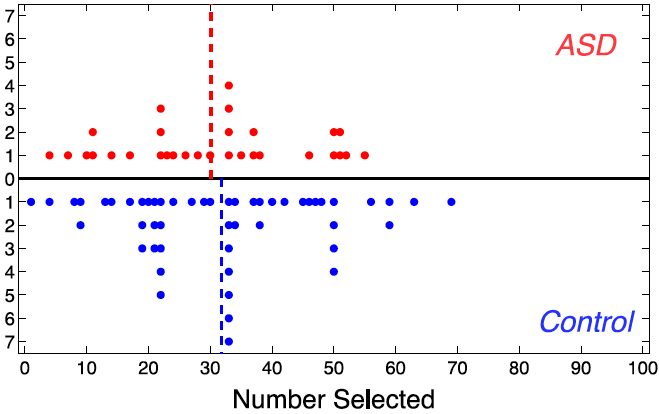
Pantelis & Kennedy (2017), Cognition — “Autism does not limit strategic thinking in the beauty contest game.”

  • ASD vs. neurotypical: statistically indistinguishable in strategic depth.
  • ASD mean ≈ 30.2, controls ≈ 31.8; same share of “higher-order” players.
  • Bayes Factor: moderate evidence for the null.

Look how nearly identical the two distributions are →

Pantelis & Kennedy (2017), Cognition — 「自閉症は美人投票ゲームでの戦略的思考を制限しない」。

  • ASD 対 定型発達:戦略的深さで統計的に区別できない
  • ASDの平均 ≈ 30.2、対照群 ≈ 31.8;「高次」プレイヤーの割合も同じ。
  • ベイズ因子:帰無仮説を中程度に支持

二つの分布がほぼ同一なことに注目 →

Pantelis & Kennedy 2017 mirror-plot: ASD guess distribution (top) vs Control (bottom) are nearly identical, with overlapping mean lines near 30-31.

Guess distributions, ASD (top) vs. control (bottom) — the dashed mean lines almost coincide. (Pantelis & Kennedy 2017, Exp 2)

Result 2 — the reversal結果2 — 逆転

Król & Król (2019), Thinking & Reasoning — “Autism limits strategic thinking after all.”

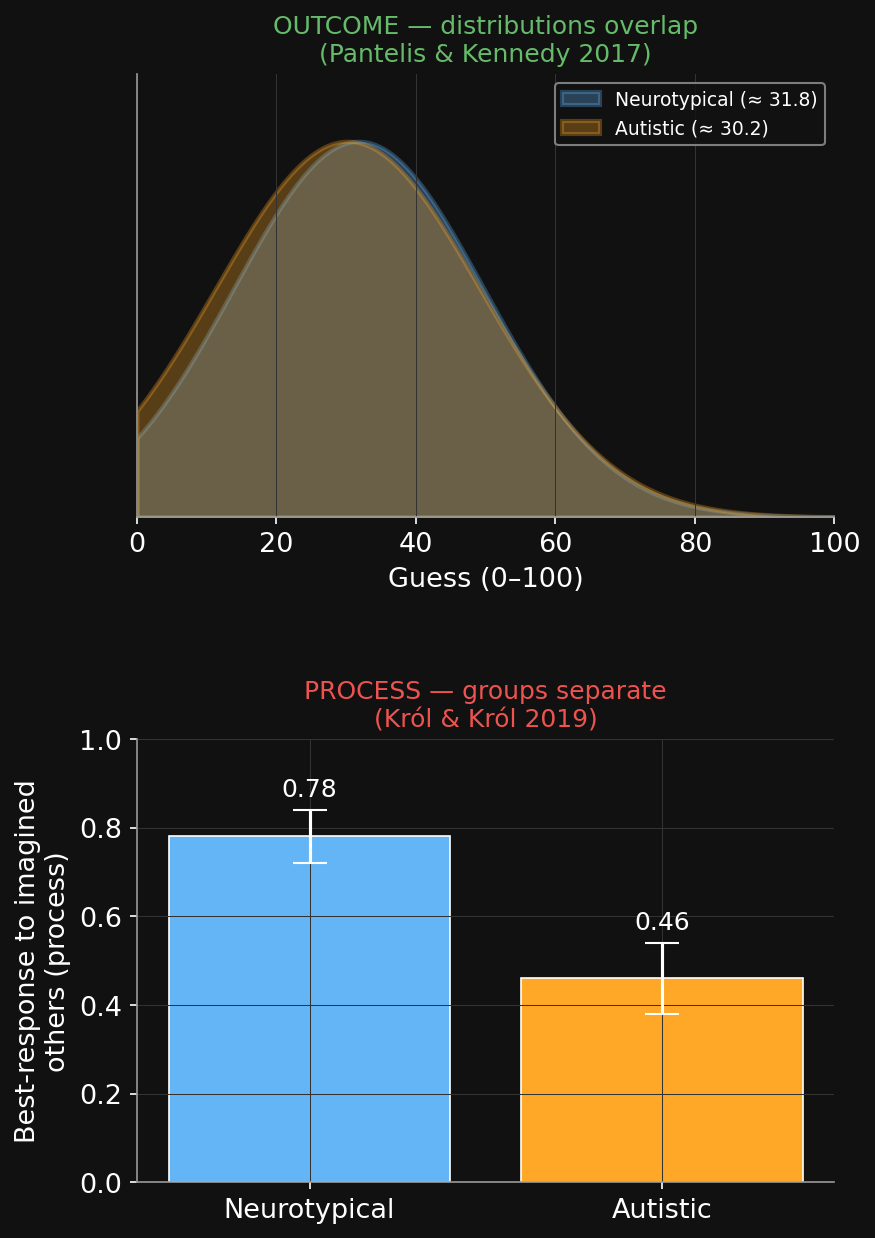
  • They replicated the outcome null — but added a payoff calculator to trace the process.
  • Neurotypicals played best-response to the hypothetical others they entered.
  • Autistic participants were less strategic in process — answers larger relative to what they attributed to others — even though the final numbers matched.

Outcome (top): same. Process (bottom): different.

Król & Król (2019), Thinking & Reasoning — 「やはり自閉症は戦略的思考を制限する」。

  • 彼らは結果の帰無を再現 — しかし過程を追跡するペイオフ計算機を加えた。
  • 定型発達者は、入力した仮想の他者に対して最適応答を行った。
  • 自閉症の参加者は過程において戦略性が低かった — 自分が他者に帰属させた値に比べて答えが大きかった — 最終的な数値は一致していたにもかかわらず。

結果(上):同じ。過程(下):異なる。

Top: ASD vs neurotypical guess distributions overlap (outcome null). Bottom: best-response process measure separates the groups.

The lesson教訓

What you measure determines what you conclude.

  • Look only at outcomes → “no difference.”
  • Trace the process → a difference appears.

An agent — or a person, or a fairness rule — can produce the right output for the wrong reasons.

MP2: same agent behavior, different internal algorithm — you debugged exactly this. MP4: a fair outcome can hide an unfair process.

何を測るかが、何を結論するかを決める。

  • 結果だけを見る → 「違いはない」。
  • 過程を追う → 違いが現れる。

エージェント — あるいは人、あるいは公平性ルール — は、間違った理由で正しい出力を生み出しうる。

MP2: 同じエージェントの振る舞い、異なる内部アルゴリズム — まさにこれをデバッグした。MP4: 公平な結果が、不公平な過程を隠しうる。

Where we are現在地

  • What is the other player thinking?相手は何を考えている? 0:00
  • People aren’t Nash人はナッシュではない 0:07
  • The beauty contest美人投票ゲーム 0:15
  • Theory of mind心の理論 0:30
  • Autism, theory of mind & the beauty contest自閉症・心の理論・美人投票ゲーム 0:53
  • Blame & intent非難と意図 1:11
  • One more gameもう一つのゲーム 1:33

6 · Blame & intent6 · 非難と意図

A vote: did he do it on purpose?投票:彼はわざとやったか?

A chairman is told a new program will increase profits and — as a side effectharm the environment. He says: “I don’t care about the environment. I just want profit.” The program runs; the environment is harmed.

Did the chairman harm the environment intentionally? Hands up.

ある会長が、新しい事業は利益を増やし — 副作用として — 環境を害すると告げられる。彼は言う:「環境はどうでもいい。利益が欲しいだけだ」。事業は実行され、環境は害された

会長は意図的に環境を害したか? 挙手で。

The side-effect effect副作用効果

Knobe (2003) — across studies:

  • 82% say he harmed the environment intentionally (≈ your show of hands).
  • Flip one word to help — same indifferent chairman — and only 23% say he helped intentionally.

He had the same mental state both times: he didn’t care. A reasons-first (blame-late) account would call both unintentional.

Yet “intentional” tracks bad vs. good, not his actual intent — the badness comes first and pulls the judgment with it.

Knobe (2003) — 複数の研究で:

  • 82% が、彼は環境を害したのは意図的だと言う (≈ 皆さんの挙手)
  • 一語を助けるに変えると — 同じ無関心な会長 — 23% しか助けたのは意図的だと言わない。

彼の心的状態は両方で同じ — どうでもよかった。理由先行(遅い非難)ならどちらも非意図的と呼ぶはず。

それでも「意図的」は彼の実際の意図ではなく悪いか善いかを追う — 悪さが先に来て判断を引きずる。
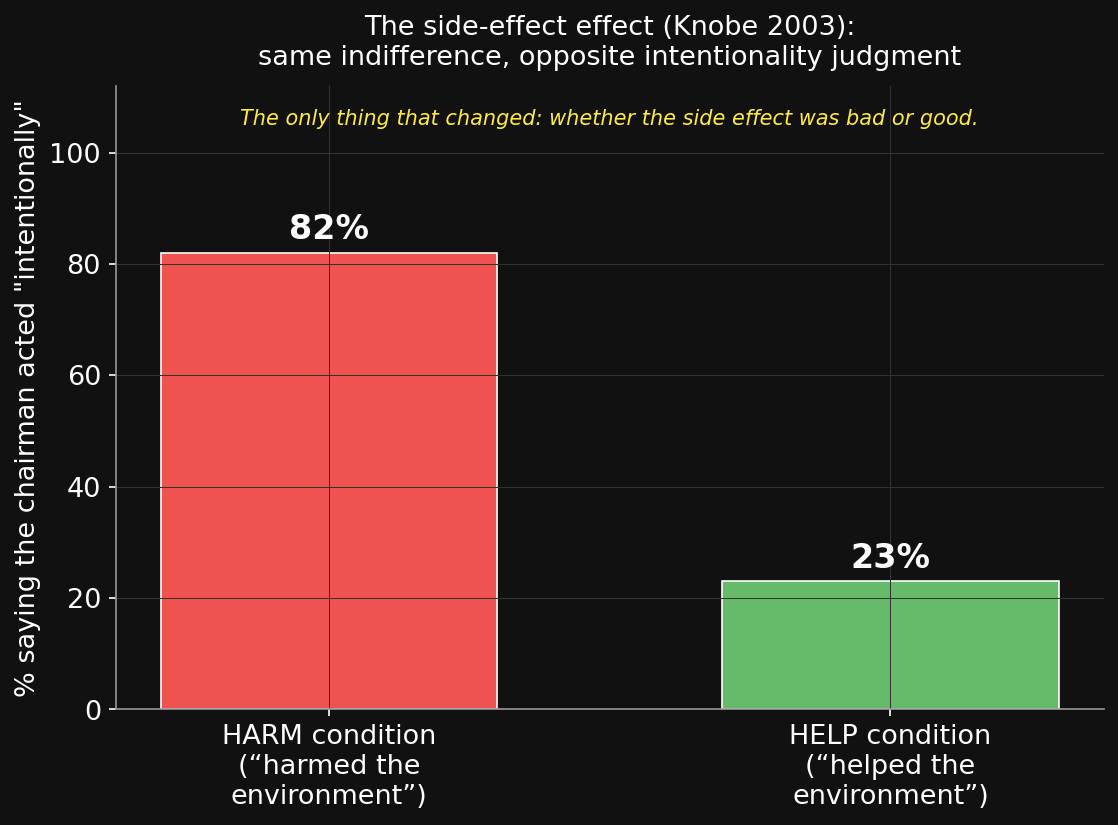
Bar chart: 82% intentional for harm condition, 23% for help condition

Blame: early or late?非難:早いか遅いか?

The Knobe asymmetry raises a deeper question: when you blame someone, when does the judgment happen?

  • Blame late: weigh cause, intent, consequences → then judge. Reasoning → blame.
  • Blame early: feel blame first, then assemble reasons to justify it. Blame → reasoning.

Two pictures of moral judgment. The evidence cuts both ways — let’s look at each.

クノービの非対称性は、より深い問いを投げかけます:誰かを非難するとき、その判断はいつ起こるのか?

  • 遅い非難: 原因・意図・結果を比べ → それから判断。推論 → 非難。
  • 早い非難: まず非難を感じ、それを正当化する理由を後から組み立てる。非難 → 推論。

道徳的判断の二つの見方。証拠は両方を支持する — それぞれ見ていきましょう。

Blame early: the gut goes first早い非難:直感が先

Evidence for blame early — quick gut reactions, with reasons built afterward (Haidt 2001, “the emotional dog and its rational tail”).

Moral dumbfounding: people stay certain even when they run out of reasons.

Julie and Mark, adult siblings on holiday, decide to sleep together once — two forms of contraception, no harm, kept secret. Was it wrong?

Most say “yes — but I can’t explain why.” Judgment outruns justification.

Reasons can’t be the whole story if there are no reasons to give.

早い非難の証拠 — 速い直感的反応、理由は後から作る(Haidt 2001「感情という犬と理性という尻尾」)。

道徳的当惑(moral dumbfounding): 理由が尽きても人は確信を保つ。

成人したきょうだいのジュリーとマークが、旅行中に一度だけ関係を持つと決める — 二重の避妊、害はなく、秘密にする。それは間違いだった?

ほとんどが「間違い — でもなぜかは説明できない」と言う。判断が正当化を追い越す。

与える理由がないなら、理由がすべてではありえない。

Blame early: re-reading the Knobe effect早い非難:クノービ効果の再解釈

Look back at the chairman. The story, his indifference, the structure — all identical. Only the outcome’s valence flipped: harm vs. help.

  • Harm → 82% call it intentional. Help → 23%.

If intentionality were read off behavior first and fed into blame, valence couldn’t move it. Instead it looks like we judge the actor bad first (he didn’t care, and harm resulted) — and that verdict pulls “intentional” along with it.

Affect about the agent shaping a judgment that’s supposed to be an input to blame: that’s blame early.

会長の話に戻りましょう。話も、彼の無関心も、構造も — すべて同一。変わったのは結果のだけ:害 対 益。

  • 害 → 82%が意図的と判断。 益 → 23%

もし意図性がまず行動から読み取られ、それが非難に入力されるなら、価がそれを動かせるはずがない。むしろ、我々はまず行為者を「悪い」と判断し(彼は気にせず、害が生じた)、その判断が「意図的」を引きずってくるように見える。

非難への入力であるはずの判断を、行為者への情動が形づくる — それが早い非難。

Evidence for blame late (Malle, Guglielmo & Monroe 2014): much blame is structured reasoning, not reflex —

  1. Detect a negative event.
  2. Was there a causal agent? (No → no blame.)
  3. Was it intentional?
    • Intentional → blame scales with the agent’s reasons (selfish → more; good goal → less).
    • Unintentional → blame scales with obligation + capacity (should they have prevented it, and could they?).

Intent raises blame for the same outcome (manslaughter vs. homicide); lack of knowledge lowers it. The inverse-planning machinery again — cause → intent → reasons.

遅い非難の証拠(Malle, Guglielmo & Monroe 2014):非難の多くは反射ではなく構造化された推論

  1. 否定的な出来事を検出。
  2. 原因となるエージェントがいたか?(いない → 非難なし。)
  3. それは意図的だったか?
    • 意図的 → 非難はエージェントの理由に応じて増減(利己的 → 増、善い目的 → 減)。
    • 非意図的 → 非難は義務 + 能力に応じて増減(防ぐべきだったか、そして防げたか)。

同じ結果でも意図が非難を高める(過失致死 対 殺人);知識の欠如は下げる。再び逆プランニングの仕組み — 原因 → 意図 → 理由。
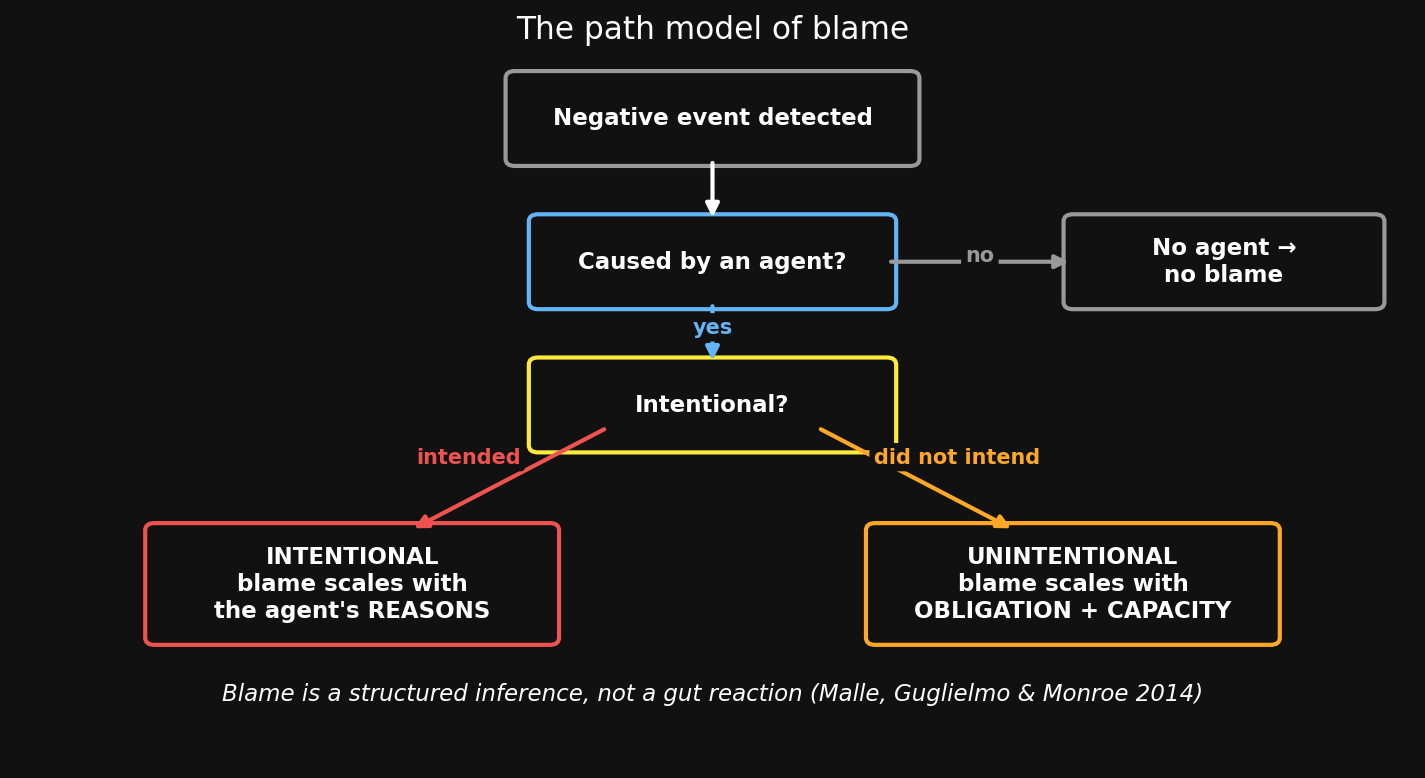
Decision tree: negative event, causal agent, intentional, then reasons or obligation+capacity

Both — and the verdict is social両方 — そして判断は社会的

So which is it? Both — fast affect and structured reasoning run, and they interact.

And the verdict isn’t even purely individual — the group bends it.

Asch (1951): pick which line matches — easy, unambiguous. But confederates all give the same wrong answer.

  • ~37% conformed on critical trials; ~75% at least once (alone: <1% errors).
  • Mostly normative (fit in), not informational — people saw the right answer and went along.

If even line-length perception bends to the group, so does moral judgment.

ではどちら? 両方 — 速い情動構造化された推論が働き、相互作用する

そして判断は純粋に個人的でさえない — 集団がそれを曲げる。

Asch (1951): どの線が一致するか選ぶ — 簡単で曖昧さがない。しかしサクラ全員が同じ誤答をする。

  • 約37%が重要試行で同調;約75%が少なくとも一度(単独なら誤答1%未満)。
  • 大半は規範的(馴染むため)で情報的ではない — 正答が見えていながら合わせた。

線の長さの知覚でさえ集団に曲げられるなら、道徳的判断もそうなる。
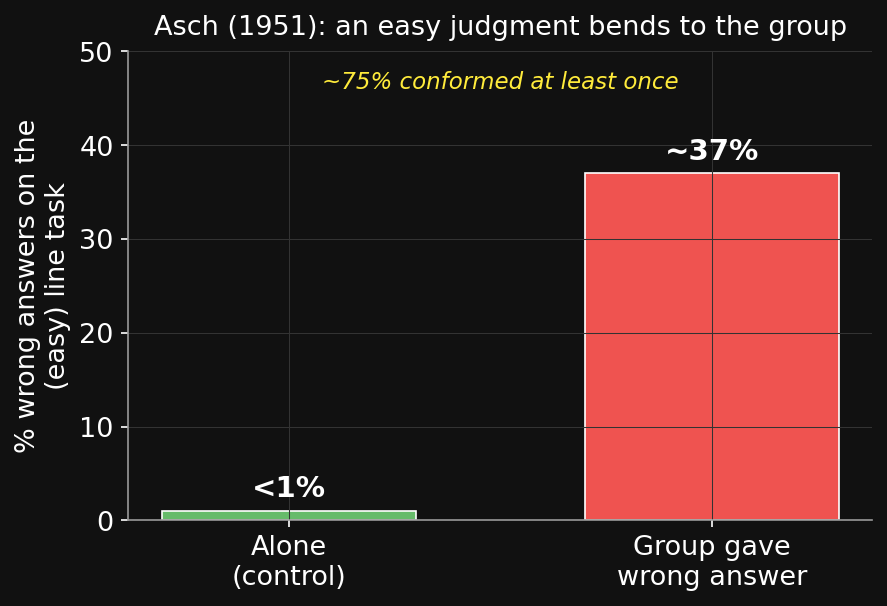
Asch conformity: alone, error rate under 1%; when the group gives a wrong answer, ~37% conform; ~75% conform at least once.

Mind perception: who can be blamed?心の知覚:誰を非難できるか?

Gray, Gray & Wegner (2007): mind perception has two dimensions —

  • Agency — planning, self-control (the capacity to do)
  • Experience — feeling pain, emotion (the capacity to feel)

Dyadic morality (Gray, Young & Waytz 2012): a moral situation is read as an intentional agent acting on a feeling patient.

Blame needs an agent with agency; harm needs a patient with experience. That’s why we argue over whether a company, an AI, or an animal can be blamed.

Gray, Gray & Wegner (2007): 心の知覚には2つの次元がある —

  • 行為主体性(agency) — 計画、自制(行う能力)
  • 経験(experience) — 痛みや感情を感じること(感じる能力)

二者間道徳(Gray, Young & Waytz 2012):道徳的状況は、意図的な主体が、感じる受け手に作用するものとして読まれる。

非難には行為主体性を持つ主体が必要;危害には経験を持つ受け手が必要。だからこそ企業AI動物を非難できるかを我々は議論する。

Where we are現在地

  • What is the other player thinking?相手は何を考えている? 0:00
  • People aren’t Nash人はナッシュではない 0:07
  • The beauty contest美人投票ゲーム 0:15
  • Theory of mind心の理論 0:30
  • Autism, theory of mind & the beauty contest自閉症・心の理論・美人投票ゲーム 0:53
  • Blame & intent非難と意図 1:11
  • One more gameもう一つのゲーム 1:33

7 · One more game7 · もう一つのゲーム

Let’s auction ¥1,0001,000円を競売します

I’m selling this ¥1,000 note. Open bidding, ¥50 increments.

  • Highest bidder wins the ¥1,000 — and pays their bid.
  • The runner-up also pays their last bid — and gets nothing.

Who’ll start at ¥50?

(We won’t really collect — but bid as if it’s real. Let’s see where it stops.)

この1,000円札を売ります。公開入札、50円刻み。

  • 最高額の入札者が1,000円を落札 — 入札額を支払う。
  • 2位の入札者も最後の入札額を支払う — そして何も得られない。

50円から始める人は?

(実際には集めません — でも本物のつもりで入札を。どこで止まるか見てみましょう。)

Why ¥1,000 sold for more than ¥1,000なぜ1,000円が1,000円超で売れたか

The dollar auction (Shubik 1971). Each next bid is locally rational — “pay ¥50 more and I might win ¥1,000” beats “pay my current bid for nothing.” But follow that logic and the bids sail past ¥1,000.

  • It’s escalation of commitment / sunk-cost entrapment — a war of attrition where quitting realizes your loss.
  • The trap isn’t in the bidders. It’s in the rules — the #2-pays mechanism is engineered to turn rational steps into a collective loss.

A theory-of-mind failure, too: you don’t reason far enough about where the other bidder’s identical logic leads.

ドル・オークション(Shubik 1971)。次の一手はどれも局所的には合理的 — 「あと50円払えば1,000円を取れるかも」は「今の入札額を払って何も得ない」より良い。しかしその論理を辿ると入札は1,000円を超えていく。

  • これはコミットメントのエスカレーション/サンクコストの罠 — 降りると損失が確定する消耗戦。
  • 罠は入札者の中ではない。ルールの中にある — 2位も支払うという仕組みが、合理的な一歩を集団の損失に変えるよう設計されている。

これは心の理論の失敗でもある:相手の同じ論理がどこへ向かうかを十分に推論していない。

The winner’s curse勝者の呪い

A second auction trap. A jar of coins worth ¥1,000; highest bid wins and pays it.

Bazerman & Samuelson (1983) — in their classic version, MBA students bid on jars worth $8:

  • Average estimate came in below the true value — yet the average winning bid was well above it, a reliable loss, with losses in more than half of auctions.

The winner is whoever most overestimated. Winning is bad news about your own estimate — and you didn’t reason about what winning reveals about everyone else.

もう一つのオークションの罠。価値1,000円のコイン瓶;最高額が落札し支払う。

Bazerman & Samuelson (1983) — 古典的な版では、MBA学生が価値8ドルの瓶に入札:

  • 平均の見積もりは真の価値を下回った — なのに平均の落札額はそれを大きく上回り、確実に損失、半分以上のオークションで損が出た。

落札者は最も過大評価した人。落札は自分の見積もりについての悪い知らせ — 落札が他者について何を明かすかを推論しなかった。

Mechanism design can be a weaponメカニズムデザインは武器にもなる

Mechanisms can be designed to exploit predictable reasoning failures:

  • Reserve prices that extract surplus (Myerson 1981)
  • Sniping on hard-close auctions (Roth & Ockenfels 2002)
  • Shill bidding, drip pricing, dark patterns

Not just an efficiency tool — a tool for extraction.

Colin Rowat makes this formal on Tuesday — first- vs. second-price, the revelation principle, incentive compatibility, optimal auctions. I give you the psychology; he gives you the mechanism.

メカニズムは、予測可能な推論の失敗を突くように設計できる:

  • 余剰を抽出する最低落札価格(Myerson 1981)
  • ハードクローズ・オークションでのスナイピング(Roth & Ockenfels 2002)
  • 見せかけ入札(shill bidding)ドリップ・プライシング、ダークパターン

効率化の道具であるだけでなく、抽出の道具。

コリン・ロワットが火曜日にこれを形式化します — 第一価格対第二価格、顕示原理、誘因両立性、最適オークション。私は心理を、彼はメカニズムを渡します。

The thread: theory of mind = decision theory backwards一本の糸:心の理論 = 逆向きの意思決定理論

  • Beauty contest → inferring the depth of others’ reasoning.
  • Inverse planning → inferring belief + desire from action.
  • Blame → inferring intent, with a moral overlay.
  • Auctions → failing to infer what winning reveals about others.

All four are one move: run your decision theory backwards on another mind.

  • 美人投票ゲーム → 他者の推論の深さを推論する。
  • 逆プランニング → 行動から信念 + 欲求を推論する。
  • 非難 → 道徳的な層とともに意図を推論する。
  • オークション → 落札が他者について明かすものを推論し損ねる。

四つはすべて一つの動き:自分の意思決定理論を、別の心に対して逆向きに動かす。

Where this sits in the courseこのコースの中での位置づけ

  • Grisha gave you the games. Mizuki the ecosystems. Catharina the fairness rules.
  • Today: the minds underneath — why people play, trust, and judge the way they do.

As you finish MP4: a fair outcome can hide an unfair process — and people will read intent into your system whether or not you put it there.

Tuesday: Colin Rowat, Agents for Economics. Thank you.

  • グリーシャはゲームを、ミズキは生態系を、カタリーナは公平性のルールを与えた。
  • 今日: その下にある — なぜ人はそのように遊び、信頼し、判断するのか。

MP4を仕上げるにあたって:公平な結果が、不公平な過程を隠しうる — そして人々は、あなたが意図を込めたかどうかに関わらず、システムに意図を読み込む。

火曜日:コリン・ロワット『Agents for Economics』。ありがとうございました。

That’s the map全体の地図

  • What is the other player thinking?相手は何を考えている? 0:00
  • People aren’t Nash人はナッシュではない 0:07
  • The beauty contest美人投票ゲーム 0:15
  • Theory of mind心の理論 0:30
  • Autism, theory of mind & the beauty contest自閉症・心の理論・美人投票ゲーム 0:53
  • Blame & intent非難と意図 1:11
  • One more gameもう一つのゲーム 1:33